Mejal Loewen
Women TalkingMejal Loewen is one of the women whose practical questions and flashes of disagreement give the Molotschna Colony’s debate about leaving its force and texture. A friendly chain-smoker with yellow fingertips, she challenges Salome Friesen’s authority to define the available choices, yet joins Salome in moments of danger and grief. Her part in the discussion is not simply to endorse a position: she presses the women to consider what their principles require for children, and what power means within the colony’s unequal order.
Identity and Presence
Mejal is a member of the Loewen family, whose women generally favor leaving, though the women’s convictions shift as the discussion proceeds. August Epp identifies her as a chain-smoker, notes her two yellow fingertips, and suspects she has a secret life; the latter is his speculation, not a confirmed account of her history. Her name means girl in Plautdietsch, the language spoken by members of the Molotschna Colony.
The meeting gives Mejal a distinct physical and conversational presence. When Salome proposes fetching soup and bringing the spelt bread she has baked so the women can eat while continuing their discussion, Mejal shrugs and rises to get the soup. The gesture registers her dislike of being told what to do by Salome even as she takes part in the practical work. Her exchanges with the other women repeatedly combine independence with participation: she resists being directed, but remains engaged in the group’s shared decisions.
Disagreement and Solidarity
Mejal’s sharpest early disagreement concerns the option to do nothing. Salome had argued that doing nothing was not genuinely an option, although letting women vote for it could itself be empowering. Mejal agreed with the point that the option was not viable, but also insisted that Salome had not been appointed to decide what counted as reality or which choices could be considered. The other Loewen women appeared to support that objection, while the Friesen women showed impatience. The colony’s women ultimately let the two families debate the options and decide what to do, setting aside doing nothing as an answer most of them dismissed.
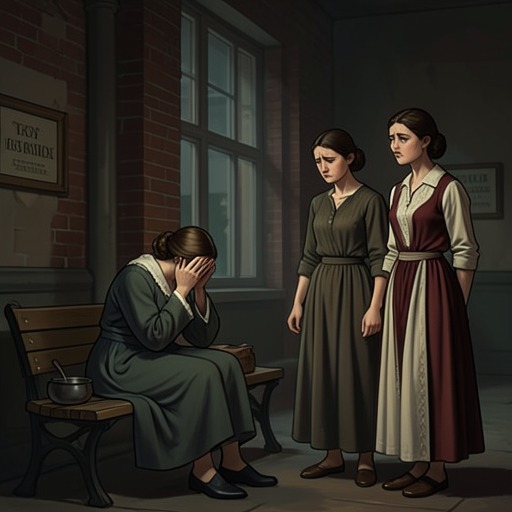
That opposition does not prevent Mejal and Salome from acting together when the discussion turns painful. After Salome speaks of leaving her son Aaron behind temporarily, Agata Friesen comforts her; Mejal, upset despite having no son of her own to leave, crosses to Salome’s side of the table and embraces her. August describes the two women as often at odds but able to unite during a crisis. Their solidarity is therefore not evidence that their disagreements have vanished. Rather, the scene shows them making room for disagreement while responding to another woman’s grief.
Children, Risk, and Hope
Mejal joins Salome in questioning the proposed age boundary for boys accompanying the women. Fifteen-year-old boys are already in the city with the men, while boys twelve and under may go with the women; Salome asks why boys aged thirteen and fourteen should be excluded. She warns that they could be vulnerable if the accused men returned and targeted them. Mejal adds that the women should not assume boys of that age are too frightening to bring along. In response, August acknowledges that adolescents can pose risks, but argues that they remain children who can be taught with direction, firm love, and patience. Mejal’s question helps make the decision about the boys a matter of both safety and responsibility, rather than an easy division between adults and children.
The women’s talk about boys also gives Mejal a place in a smaller, more hopeful exchange. When Neitje Friesen jokes that boys show love by throwing horse manure at girls, and Autje Loewen replies that a loving boy would intentionally miss, Salome describes her hope that Miep might one day be missed. Mejal agrees that this is the day every mother hopes for, a thought that sustains them through difficult times. The exchange does not erase the threat behind their discussion. Instead, it holds that threat beside a modest hope that boys can learn care and restraint.
Faith, Power, and the Decision to Leave
Mejal’s contribution to the case for leaving is inseparable from the women’s religious debate. Agata Friesen argues that pacifism is central to Mennonite faith and that staying would risk drawing the women into violence, either as its targets or its agents. Leaving, in this account, offers a way to protect children and bear witness to peace. Mejal acknowledges Agata’s reasoning, nodding after taking a long drag from her cigarette, and urges the women to move on. Agata later argues that leaving better enables them to practice pacifism, love, and forgiveness, and to teach these values to their children rather than simply submit to their fathers’ expectations.
Mejal does not treat power as a concern that belongs only to men. As Ona Friesen discusses the power exercised by Peters and the elders, and the way boys and men have learned that lesson, Mejal asks whether everyone wants some kind of power. Ona answers uncertainly; Mariche Loewen responds sarcastically, teasing Ona about her doubts concerning power, authority, and love. Mejal’s question keeps the discussion from reducing power to the conduct of particular men: it asks how broadly the desire for it runs, without resolving what a just use of power might be.
The women’s debate over scripture also exposes the restrictions shaping their choices. Salome argues that women cannot know exactly what the Bible says because they cannot read it, and that their supposed duty to submit to husbands reaches them through their husbands’ interpretations. Mejal asks who else would interpret the Bible for them, recognizing that the interpreters are men. Salome replies that leaving need not amount to biblical disobedience when women have been denied direct access to the text. Mejal rolls her eyes and her cigarette, a small gesture that registers her response without supplying a simple resolution to the theological argument.
Narrative Role
Mejal’s characterization emerges through such interventions rather than through a separate account of her past or a fully narrated conclusion to her story. She questions who has the authority to define options, presses the group to consider boys left between childhood and adult membership, joins Salome in grief, and tests how power and religious authority operate. Her relationship with Salome is especially revealing: their friction persists, but it does not prevent mutual recognition when the stakes rise. The evidence establishes Mejal as a participant in the women’s collective deliberation, but does not specify her individual final circumstances or outcome.